


Unless you have a hell of a lot of historic and military background that most people wouldn’t know, the beginning of this New York Times article seems fairly innocuous:
The Trump administration has approved a $2.8 billion sale of heavy bombs to Israel, according to a U.S. official, in what would be among the largest deliveries of U.S. munitions there even as American public support for the country declines.
The proposed sale would include 40,000 one-ton bombs whose use by Israel in Gaza and Lebanon has drawn international anger because of the civilian harm caused by their wide blast radius.
Human rights groups and some foreign governments have condemned Israel for dropping the giant munitions in densely populated areas, sometimes killing dozens of civilians in strikes targeting just one individual.
The package would include 20,000 each of America’s 2,000-pound MK-84 and BLU-117 bombs. It would also provide Israel with 20,000 bunker-busting I-2000 penetrator warheads, which explode on delay after smashing through an outer surface like soil, rock or concrete.
The blast from a 2,000-pound bomb can be lethal at more than 1,000 feet and leave a crater as deep as 50 feet. Israel provoked a fierce outcry after it dropped hundreds of the heavy bombs on Gaza.
There is a subtext here: that Israel values the destructive power of these weapons more than it values avoiding civilian casualties. The reader is encouraged to understand Israel’s interest in 2,000-pound bombs principally through the civilians they can kill.
Almost everything in the opening reinforces that interpretation: “one-ton bombs,” “wide blast radius,” “giant munitions,” “dozens of civilians,” “just one individual,” “lethal at more than 1,000 feet,” and “50-foot crater.”
We see the same loaded language in the photo caption:
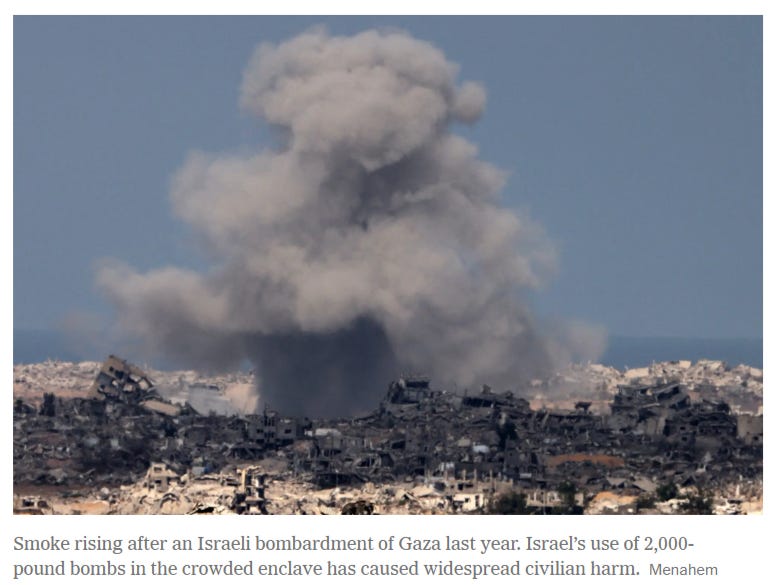
What is largely absent are the military variables that explain why an air force might buy or use such weapons in the first place: hardened targets, underground facilities, penetration requirements, guidance systems, alternative weapons and the military importance of the target. A lot of variables go into choosing a target and selecting the appropriate weapon to achieve an objective. Almost none of that information is available to the New York Times, its selected “experts,” or NGO critics of Israel.
I cannot prove that every Israeli use of a 2,000-pound bomb was lawful. The point is that when the UN or Amnesty list targets that they believe had no reason for the choice of a large bomb, they are making a large leap from “here’s what we know” and “Israel had no valid reason to choose that target with that bomb at that time.” Unless Israel chooses to leak some of its intel, they never will know the IDF reasons. The assumption that Israel is either purposefully targeting civilians or is uncaring about the potential effects on civilians is baseless, and yet it is a guiding principle behind their reports. The NYT here is not quite that bad but it sure is trying to give that impression. The Times does not identify a specific recent strike involving a 2,000-pound bomb that has been judicially determined to be unlawful, nor does it give readers the target-specific facts necessary to decide whether the strikes it alludes to were disproportionate.
Its phrase “strikes targeting just one individual” is particularly revealing.
